Capitaland Investment Sheds Ground, Leaves Investors in the Dust
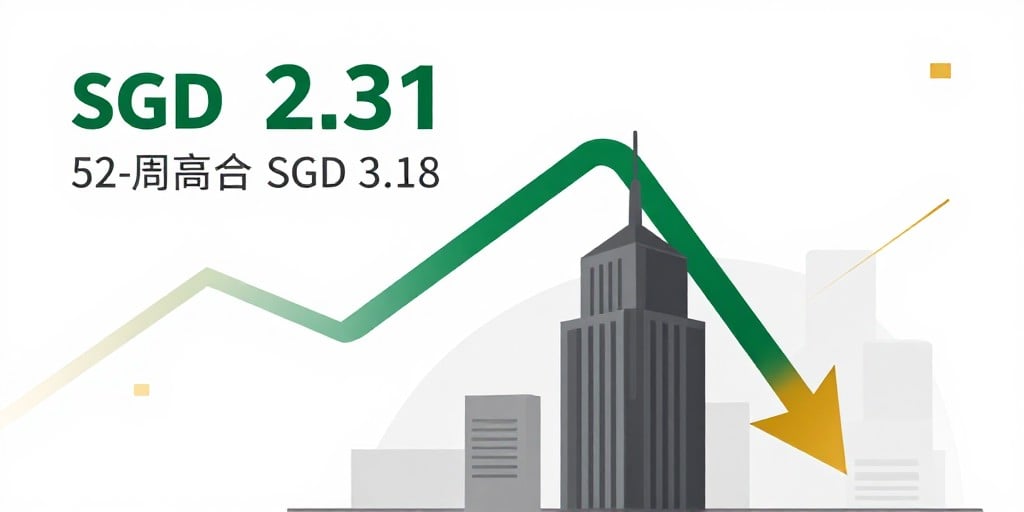
Capitaland Investment Ltd‑Singapore (ticker 9CI.SI) slipped –0.86 % during the 24‑hour trading window that closed at 09:59 AM Central Europe on Friday, 23 September 2026. The share now trades at SGD 2.38 on the Singapore Exchange, a price that is below the simple moving average of the last 200 days (SGD 2.71).
With a market capitalization of SGD 9 billion, Capitaland’s stock is a relatively thin‑traded asset, as only SGD 27.1 million of its shares were exchanged in the last 24 hours. The company’s current supply of 5 billion shares suggests that liquidity is limited and any sizeable sale or purchase could trigger a pronounced price swing.
The stock’s recent performance is nothing short of alarming. Since the close of last month’s end, Capitaland has fallen –11.83 %. The peak of the past 52 weeks was SGD 3.18 (on 02 October 2026), while the trough was SGD 2.29 (on 21 October 2026). In other words, the company’s price range over the last year has contracted sharply, and the current price sits near the bottom of that band.
Context from the Broader Market
Capitaland’s decline mirrors a broader malaise among Singaporean real‑estate and industrial stocks:
| Stock | 24‑h % Change | Current Price | Market Cap | P/E Ratio |
|---|---|---|---|---|
| City Developments (C09.SI) | –1.55 % | SGD 7.16 | SGD 4.8 bn | 7.99 |
| Uol (U14.SI) | –1.65 % | SGD 7.94 | SGD 6.7 bn | 12.65 |
| Hafnia (HAFN) | +3.54 % | USD 10.33 | USD 4.8 bn | 7.94 |
| Joyy (JOYY) | –1.35 % | USD 83.42 | USD 4.1 bn | 20.21 |
| Kulicke & Soffa Industries (KLIC) | –9.86 % | USD 73.4 | USD 4.3 bn | 37.41 |
While Hafnia defied the trend with a modest gain, the rest of the group posted losses, many exceeding 5 %. The outlier status of Hafnia underscores the sector’s fragility and the increasing risk that investors face when betting on the real‑estate development market in Singapore.
Why Capitaland’s Decline Matters
Capitaland Investment Ltd‑Singapore is a major player in Singapore’s property development landscape. Yet, the company’s current trajectory indicates a potential erosion of investor confidence. A –11.83 % drop in a single month signals that the firm’s growth prospects are being questioned, and the fact that its share price is now below its 200‑day moving average amplifies that concern.
Moreover, with a P/E ratio of 7.99 (City Developments) and 12.65 (Uol) for its peers, Capitaland’s valuation appears stretched relative to industry averages, especially given its declining market cap. If the company cannot reverse its downward trend, shareholders may face a substantial loss of capital, and new investors may find the stock a risky proposition.
Bottom Line
Capitaland’s recent slide is not an isolated incident—it is part of a larger pattern of weakness in Singapore’s real‑estate sector. The company’s current trading price, coupled with its declining market cap and low liquidity, presents a stark warning to investors. In a market already bruised by volatility, the stakes are high: buy at the right time, or risk being left with a depreciated asset.