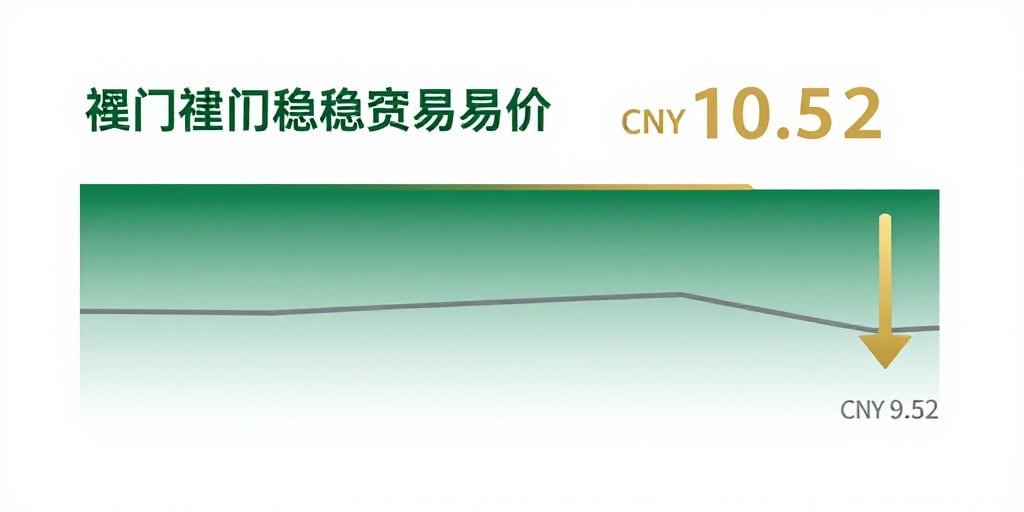
Corporate Snapshot: Fujian Jinsen (002679.SZ) Holds Ground Amid Market Volatility
Fujian Jinsen, listed under ticker 002679.SZ, closed its trading session at a neutral 0 % change, reflecting a stagnant 24‑hour period that concluded at 11:04 PM Central Europe on Thursday, 22 October. Despite the lack of momentum, the share price remains firmly anchored near CNY 9.8, a figure that investors can currently access on major exchanges.
Market Capitalization and Liquidity
- Market cap: CNY 2.5 bn
- Shares outstanding: 235.7 mn
- 24‑hour volume: CNY 276.3 mn
These numbers underscore a relatively shallow market, where a single trade can sway perception but rarely alters the broader trajectory. With a market capitalization that ranks the stock in the lower echelons of the Shenzhen market, Fujian Jinsen’s capacity to influence sectoral indices is limited—yet the company remains a barometer for regional sentiment.
Technical Landscape
- Simple Moving Average (200 days): CNY 9.52
- 52‑week high: CNY 16.92 (17 Nov 2025)
- 52‑week low: CNY 7.35 (21 Jul 2026)
The current price sits just above the 200‑day moving average, suggesting a mild bullish bias. However, the proximity to the 52‑week low indicates a fragile position, vulnerable to sudden shifts in investor confidence.
Recent Performance Context
Since the close of last month’s trading, Fujian Jinsen has declined 4.01 %, a drop that is not merely a statistical footnote but a sign of underlying weakness. In contrast, the broader Fujian‑based sector experienced a limit‑up rally on 21 October, with Pan Tan Development reaching a full‑day surge and other regional names (Haimo Innovation, Luoqiao Information, Zhangzhou Development, Xiamen Xinda, Xiamen Port) following suit. This local rally was partly attributed to a surge in Fujian‑EU trade volume, surpassing the 2,000‑bil‑yuan threshold for the first three quarters of the year.
Yet, while the provincial indices saw a modest lift, the national market remained fractured. The discrepancy between the regional surge and the flat performance of Fujian Jinsen highlights a critical point: regional momentum does not automatically translate to individual corporate resilience.
Peer Comparison: A 24‑Hour Standstill
| Stock | Ticker | 24‑hr Change | Current Price (CNY) | Market Cap (CNY) | P/E Ratio |
|---|---|---|---|---|---|
| Ceep | 300172.SZ | 0 % | 4.28 | 3 bn | 33.13 |
| Zhengzhou Qianweiyangchu F | 001215.SZ | 0 % | 30.02 | 3 bn | 48.56 |
| Transtek | 300562.SZ | 0 % | 12.71 | 3 bn | 29.20 |
| Zhejiang Cheng Yi Pharmaceutical | 603811.SS | 0 % | 6.57 | 3 bn | 16.96 |
| Shenzhen Neoway | 688159.SS | 0 % | 31.95 | 3 bn | 87.04 |
All peers share the same flat 0 % trading outcome, underscoring a broader market inertia that is not unique to Fujian Jinsen. However, their respective price‑to‑earnings ratios vary dramatically, reflecting differing valuations and investor expectations. Fujian Jinsen’s omission of a disclosed P/E ratio suggests either a lack of earnings or a strategic decision to remain outside the traditional valuation metrics, further complicating its assessment.
Critical Assessment
The juxtaposition of Fujian Jinsen’s stagnant price against the backdrop of regional bullishness raises a pivotal question: Is the company merely lagging, or is it actively resisting the tide of market optimism? The answer appears to lie in structural factors—limited liquidity, modest capitalization, and a technical positioning just above the long‑term moving average that offers little cushion against a downward shock.
Moreover, the company’s current market price sits far below the 52‑week high but well above the low, a narrow window that can be easily breached if sectoral sentiment turns negative. Given the flat trading volume and the absence of a clear earnings narrative, Fujian Jinsen risks being perceived as a speculative play rather than a sustainable investment.
Bottom Line
Fujian Jinsen’s status quo—flat change, modest market cap, and a price hovering just above its 200‑day moving average—reflects a company that is neither benefiting from nor contributing to the regional rally. Investors should scrutinize the underlying fundamentals and remain wary of a market that is poised for volatility. The company’s current trajectory suggests that any substantial upside will likely require a fundamental shift in strategy or a significant improvement in operational performance, rather than a continuation of the current trend.