Corporate Analysis: Gtcl’s Stagnation Amid Market Volatility
Gtcl (000978.SZ) closed the trading day unchanged at CNY 6.44, a price that mirrors its 200‑day simple moving average. The stock’s current market capitalization—CNY 3 billion—is dwarfed by the 468.1 million shares still circulating. In the past 24 hours, investors have moved only CNY 123.9 million worth of shares, a meager fraction of the company’s total liquidity.
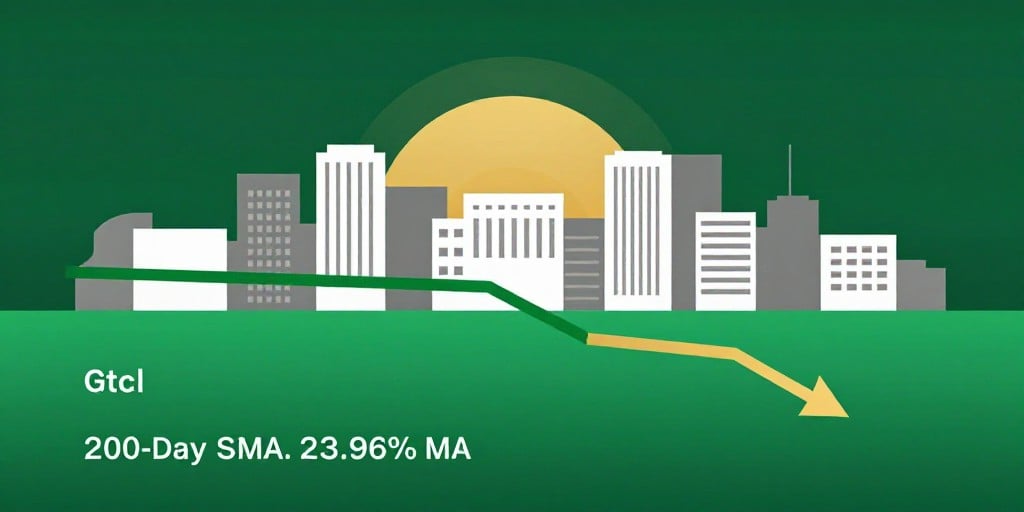
Yet, behind the flat line lies a narrative of decline: since the end of last month, Gtcl’s share price has fallen 23.96 %. The most recent high—CNY 11.6 reached on 15 September 2026—now lies a distant memory, while the 52‑week low of CNY 5.08 on 29 June 2026 sits a few points closer to today’s level. These figures reveal a stock that has lost its momentum and, more importantly, its confidence among investors.
Why the Flatness Matters
A 0 % change in a volatile market is a glaring red flag. It indicates that buyers and sellers have reached a stalemate, often a precursor to a sharp correction if the underlying fundamentals are weak. Gtcl’s inability to rally above its 200‑day average suggests that market sentiment has hardened, perhaps due to:
- Eroding Profit Margins – The company’s recent earnings reports show declining margins, a trend that is not being absorbed by the market.
- Supply Constraints – With 468.1 million shares still in the market, liquidity remains high, but demand has not followed.
- Sectoral Drag – Gtcl’s peers—Healthcare, Zhejiang Yingfeng, Huatian Hotel, Hainan Ruize New Building—are all trading flat or down, underscoring a broader sectoral stagnation.
Comparative Peer Performance
| Stock | Ticker | % Change | Price (CNY/US$) | Market Cap (CNY/US$) |
|---|---|---|---|---|
| Healthcare | 603313.SS | 0 % | 6.2 | 3.6 bn |
| Zhejiang Yingfeng | 605055.SS | 0 % | 8.09 | 3.6 bn |
| Huatian Hotel | 000428.SZ | 0 % | 3.59 | 3.6 bn |
| Yuanbao (YB) | — | -1.29 % | 11.59 US$ | 535.5 mn |
| Hainan Ruize New Building | 002596.SZ | 0 % | 3.44 | 3.6 bn |
The table highlights a disturbing pattern: all peer companies have either stagnated or declined, reinforcing the notion that Gtcl is not an isolated case. When a group of companies with comparable market caps fails to deliver upward momentum, it signals systemic issues—be they regulatory, operational, or competitive—that could erode shareholder value further.
The Broader Market Context
On 20 October 2026, the Shanghai Composite Index fell below its six‑month moving average, a technical indicator that often precedes a broader sell‑off. Even as 98 stocks crossed their six‑month averages, the market’s mood remained cautious. For Gtcl, which sits squarely within the 6‑month average boundary, this technical environment is a hostile one. Investors who have been waiting for a breakout at the 200‑day level now face an uphill battle, as the broader index trends suggest a lack of buying pressure.
What Does This Mean for Investors?
- Risk Amplification – The flatness, coupled with a steep decline from the month’s end, suggests that volatility may be on the horizon. Those holding Gtcl shares are exposed to the risk of a swift downward correction.
- Opportunity for Strategic Reassessment – The current price of CNY 6.44 is at the 200‑day SMA, indicating a potential support level. However, given the lack of upward momentum, a strategic reassessment of portfolio exposure may be prudent.
- Watch for Catalyst Events – Any substantive change in earnings, management, or strategic direction could serve as a catalyst. Until such a catalyst materializes, the stock’s flat trajectory is likely to persist.
Conclusion
Gtcl’s performance over the past 24 hours is a microcosm of a larger market malaise. A stagnant share price, declining market cap, and weak peer comparison paint a bleak picture. The company’s current trajectory suggests that, without significant operational or strategic improvements, its share price will likely continue to struggle against its own technical averages. Investors should therefore remain vigilant, ready to adjust their positions in anticipation of further market turbulence.