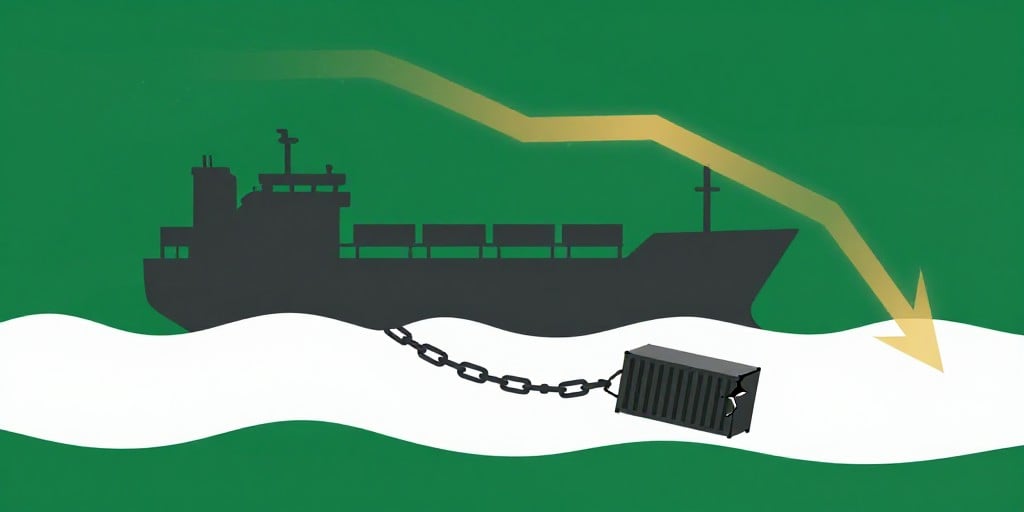
HMM Co. Faces a Sharp Decline Amid Market Volatility
In a stark illustration of the fragility that plagues even the most established shipping conglomerates, HMM Co. Ltd. (011200.KS) slid 2.29 % in the 24‑hour window concluding at 03:57 AM Central Europe on Thursday, 22 March 2026. The carrier’s shares now trade at approximately KRW 22,700, a stark reminder that market sentiment can shift with the slightest perturbation.
Quantitative Dissection
- Market Capitalization: KRW 22.1 trillion
- Available Shares: 943.2 million
- 24‑Hour Turnover: KRW 30.7 billion
- Simple Moving Average (200 days): KRW 20,690.2
- 52‑Week High/Low: KRW 24,950 / KRW 17,910
Despite a 11.14 % rise since the close of the previous month, HMM’s current price remains dwarfed by its 52‑week apex, signaling a possible correction that is already underway. The disparity between the current trading price and the 200‑day moving average suggests that the stock is trading below its medium‑term trend, an uncomfortable position for investors who favor momentum.
Comparative Performance
| Stock | Ticker | 24‑h Movement | Current Price | Market Cap | P/E |
|---|---|---|---|---|---|
| Meritz | 138040.KS | ‑1.3 % | KRW 131,000 | KRW 20.8 trillion | 9.27 |
| Posco | 005490.KS | ‑3.97 % | KRW 293,000 | KRW 22.8 trillion | 16.39 |
| SK | 034730.KS | ‑6.45 % | KRW 42,003.27 | KRW 23.3 trillion | 3.51 |
| Hanmi Semiconductor | 042700.KS | ‑5.71 % | KRW 200,500 | KRW 19 trillion | 101.24 |
| SK Innovation | 096770.KS | ‑9.14 % | KRW 144,200 | KRW 25.2 trillion | – |
HMM’s descent is not an isolated incident. The broader sector is experiencing a pronounced downturn, with peer companies similarly eroding market value. This collective slide underscores systemic pressures—whether from fluctuating freight rates, geopolitical tensions, or escalating environmental compliance costs—that are reshaping the maritime logistics landscape.
Why HMM Is Vulnerable
Commodity‑Driven Revenue Shipping revenues are inextricably linked to global trade flows. A slowdown in commodity demand—particularly for bulk and containerized freight—directly compresses HMM’s earnings.
High Fixed Costs Fleet maintenance, crew wages, and port fees constitute a substantial portion of operating expenses. In a downturn, these costs do not diminish proportionally, squeezing margins.
Regulatory Headwinds New emission standards (IMO 2027, IMO 2030) will necessitate costly retrofits or new vessels. HMM’s current asset mix may be ill‑suited to meet these obligations without significant capital expenditure.
Competitive Pressures The entrance of low‑cost carriers and consolidation among existing players intensifies price wars. HMM’s market share could erode if it cannot maintain cost leadership.
Call to Action for Investors
The data paints a clear narrative: HMM’s valuation has become precarious. For discerning investors, this presents an opportunity to reassess the risk–reward profile. While the company’s core logistics expertise remains intact, the convergence of macro‑economic headwinds and sectoral pressures demands caution. A prudent strategy would involve:
- Conducting a thorough debt‑to‑EBITDA analysis to gauge leverage resilience.
- Monitoring freight rate indices to anticipate revenue trajectories.
- Evaluating HMM’s capital allocation plans for fleet renewal and environmental compliance.
In an era where the shipping industry is poised for transformative change, those who ignore the warning signs risk being swept into the inevitable downturn.