Corporate News
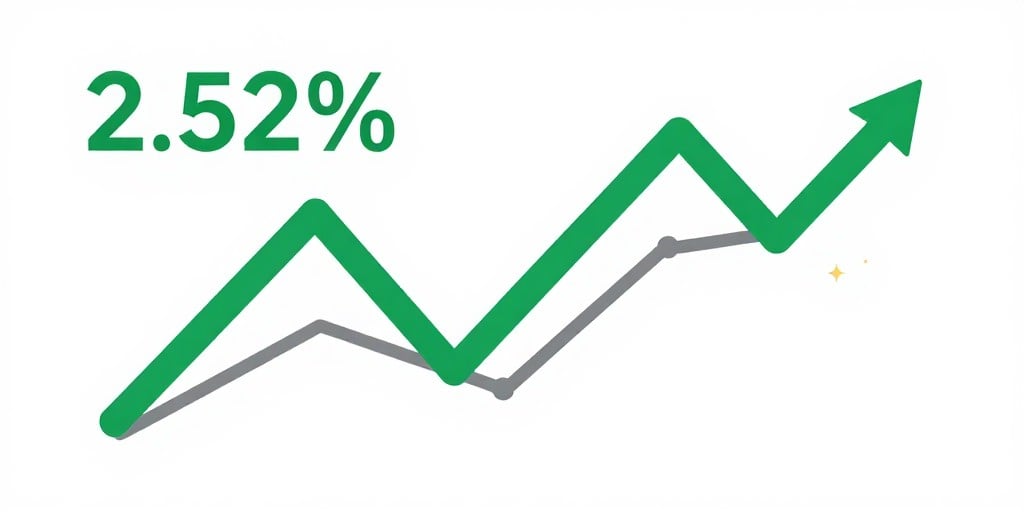
The Indian stock market concluded Wednesday 21st with Bajaj Finance (BAJFINANCE.NS) experiencing a decline of 2.52 % over the 24‑hour trading window that ended at 12:33 AM Central Europe. At the time of reporting, a single share of the company could be acquired for approximately INR 957.35 on the most active exchanges.
Bajaj Finance’s liquidity is substantial, with a current supply of 6.2 billion shares in circulation. The company’s market capitalization stands at INR 6.1 trillion, a figure that underscores its prominence within the Indian financial services sector. In the past 24 hours, trading activity generated roughly INR 8 billion in turnover, reflecting continued investor interest despite the recent dip.
Trend Analysis
Since the close of the previous month, Bajaj Finance’s stock price has slipped by 6.26 %. A simple moving average (SMA) calculated over the last 200 days sits at INR 974.8, suggesting that the current level is below a key long‑term trendline. Over the past year, the share has ranged from a high of INR 1,176.4 (recorded on 8 March 2026) to a low of INR 787.9 (on 23 March 2026), indicating a volatility envelope within which investors have navigated.
Peer Performance
The broader market context reveals a mix of downward pressures across several leading Indian equities:
- Axis Bank (AXISBANK.NS): Down 4.19 %, trading at INR 1,236. The bank’s market capitalization is INR 4 trillion, and its price‑earnings ratio (P/E) is 13.63.
- Titan (TITAN.NS): Down 0.46 %, priced at INR 4,424.2. Titan’s market cap is INR 3.9 trillion, with a P/E of 68.18.
- HCL Technologies (HCLTECH.NS): Down 0.01 %, trading at INR 1,379.9. The company’s market cap is INR 3.7 trillion, and its P/E is 19.64.
- Infosys (INFY.NS): Down 2.63 %, priced at INR 1,130.7. Infosys has a market cap of INR 4.6 trillion and a P/E of 14.31.
- Hindustan Unilever (HINDUNILVR.NS): Down 2.14 %, trading at INR 1,853.2. The consumer‑goods giant’s market cap is INR 4.4 trillion, with a P/E of 41.55.
These figures illustrate a market that, while experiencing modest declines in key sectors, remains anchored by strong valuations and sizeable capitalization figures.
Bottom Line
Bajaj Finance’s recent performance, set against the backdrop of peer declines, signals a cautious but resilient environment for investors. The company’s robust market capitalization and liquidity position it well to weather short‑term volatility, while the 200‑day SMA and historical price extremes provide context for potential recovery or further correction. Market participants will likely monitor upcoming earnings releases and macroeconomic indicators to gauge the trajectory of this and related stocks.