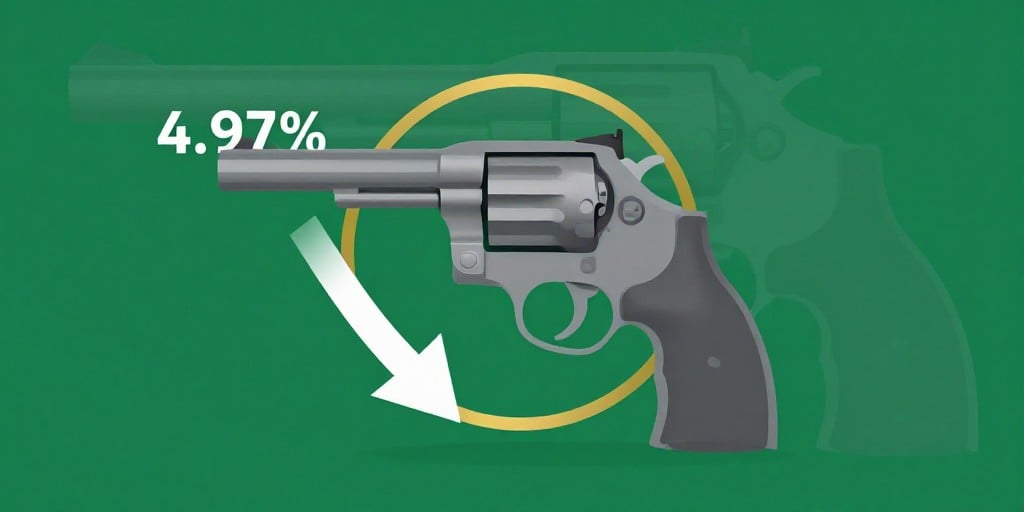
Smith & Wesson Brands (SWBI) Market Snapshot
- 24‑hour change: −4.97 %
- Last closing price: USD 14.35
- Shares outstanding: 44.8 million
- Market capitalization: USD 677.1 million
- Volume (last 24 h): USD 8.5 million worth traded
- Monthly performance: +2.65 % since the previous month‑end
- 200‑day simple moving average: USD 13.90
- 52‑week high: USD 17.56 (18 June 2026)
- 52‑week low: USD 8.14 (20 November 2025)
Comparative Performance of Peer Stocks (24 h)
| Ticker | 24‑h change | Current price | Market cap (USD mn) | P/E |
|---|---|---|---|---|
| TRNS (Transcat) | −5.18 % | USD 81.84 | 807.9 | 236.77 |
| PUBM (Pubmatic) | 0 % | USD 17.17 | 795.3 | — |
| RJET (Republic Airways) | +2.16 % | USD 17.19 | 804.8 | 0.43 |
| GHM (Graham) | −5.76 % | USD 64.41 | 802.2 | 65.59 |
| IBCP (Independent Bank – Mich) | +2.70 % | USD 36.96 | 799 | 10.45 |
Contextual Overview
Smith & Wesson Brands, Inc., a longstanding U.S. manufacturer of firearms and related accessories, remains listed on the Nasdaq. Its product portfolio spans pistols, revolvers, rifles, handcuffs, and ancillary items for both consumer and law‑enforcement markets. The firm conducted its initial public offering on 4 November 1998 and has since established a stable, albeit cyclical, presence in the global defense and security sectors.
Forward‑Looking Analysis
- Short‑Term Volatility: The recent 4.97 % decline aligns with broader sectoral pressure observed in the firearms industry, which is currently experiencing heightened regulatory scrutiny and shifting consumer sentiment.
- Relative Valuation: At a 200‑day SMA of USD 13.90, SWBI trades slightly above its moving average, suggesting modest upside potential if the firm can sustain earnings momentum.
- Peer Benchmarking: Compared to contemporaries such as Transcat and Graham, SWBI’s price movements are less severe, indicating relative resilience. However, its P/E ratio is not disclosed, which limits direct valuation comparisons.
- Market Position: With a market cap of USD 677.1 million, Smith & Wesson remains a mid‑cap player, positioned to leverage strategic partnerships or product diversification to capture emerging market segments.
Conclusion
Smith & Wesson Brands exhibits a stable yet cautious performance profile amid a challenging regulatory landscape. Its recent price trajectory, coupled with a solid market capitalization and a favorable position relative to peer stocks, suggests that investors should monitor forthcoming earnings releases and sector developments closely. A disciplined approach, grounded in the company’s historical resilience and strategic initiatives, will be essential for navigating the next quarter of market activity.