Corporate News
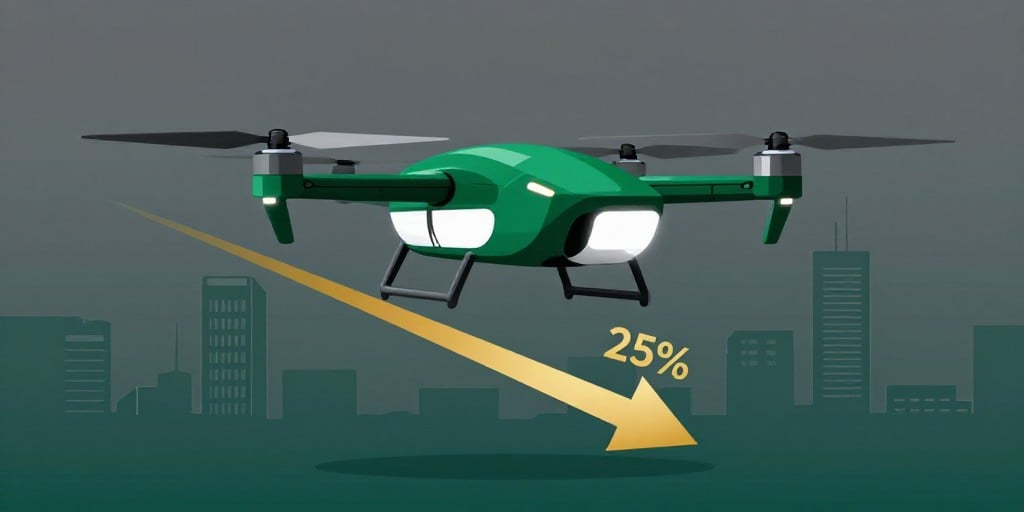
Ehang (EH) has slipped marginally, trading up only 0.15 % during the 24‑hour period ending at 08:32 AM Central Europe on Monday 26 th. The share price sits at roughly USD 3.40 on major exchanges, a figure that underscores the company’s precarious valuation in a market that has already punished it with a 25.22 % decline since the end of the previous month. With a market capitalisation of USD 257.5 million and only USD 1.8 million of trading volume over the past day, the stock’s liquidity is alarmingly thin.
The company’s technical indicators paint an even bleaker picture. A 200‑day simple moving average sits at USD 8.32, starkly above the current price. The all‑time high of USD 19.02 was recorded on 29 October 2025, while the 52‑week low of USD 3.30 fell on 23 October 2026. Ehang’s share price is now operating at a mere 17 % of its peak and has failed to climb above its recent trough.
When examined alongside its peers, the lack of momentum becomes even more pronounced. Cosmos (002133.SZ) remains flat at CNY 2.69, Zhejiang Taimei Medical (2576.HK) only nudged up 0.82 % to HKD 4.19, and Liuzhou Chemical (600423.SS), Zhejiang Cady (603073.SS), and Xljk (002105.SZ) all traded unchanged at their current levels. All of these firms boast market capitalisations in the CNY 2‑2.1 billion range, dwarfing Ehang’s USD 257.5 million. The disparity is not merely numerical; it reflects a fundamental imbalance in investor confidence and market demand.
EHang Holdings Limited, a holding company that develops and markets autonomous aerial vehicle (AAV) technology, claims to offer proprietary passenger‑carrying AAVs, command‑and‑control systems, and commercial solutions to a global customer base. Yet the company’s financial reality tells a different story. With a total of 75.7 million shares outstanding, the supply of stock far exceeds the demand, driving the price to its current low. Moreover, the company’s operational revenue streams have not yet translated into sustained profitability, leaving investors wary of the long‑term viability of the AAV business model.
In an industry that is rapidly evolving, Ehang’s sluggish performance underscores the necessity for tangible milestones—real‑world deployments, regulatory approvals, and robust revenue growth. Until such proof is delivered, the company’s stock remains a speculative play, susceptible to sharp corrections that could further erode its already fragile market capitalisation.